Showing posts with label abutilon. Show all posts

Wednesday, September 21, 2011

As the Season Changes

Blue Ginger
Dichorisandra thyrsiflora

The end of the week heralds the official beginning of Fall.  The garden is beginning to show its Fall colors already.  Since the trimming has gotten away from me, the Blue Ginger is blooming underneath the overpowering branches of Purple Firespike which won't bloom until late winter.

Flowering Maple
Abutilon

Flowering Maple has bloomed pretty much non-stop since Spring, but seems to have more blooms than ever now that the nighttime temperature has dropped a bit.

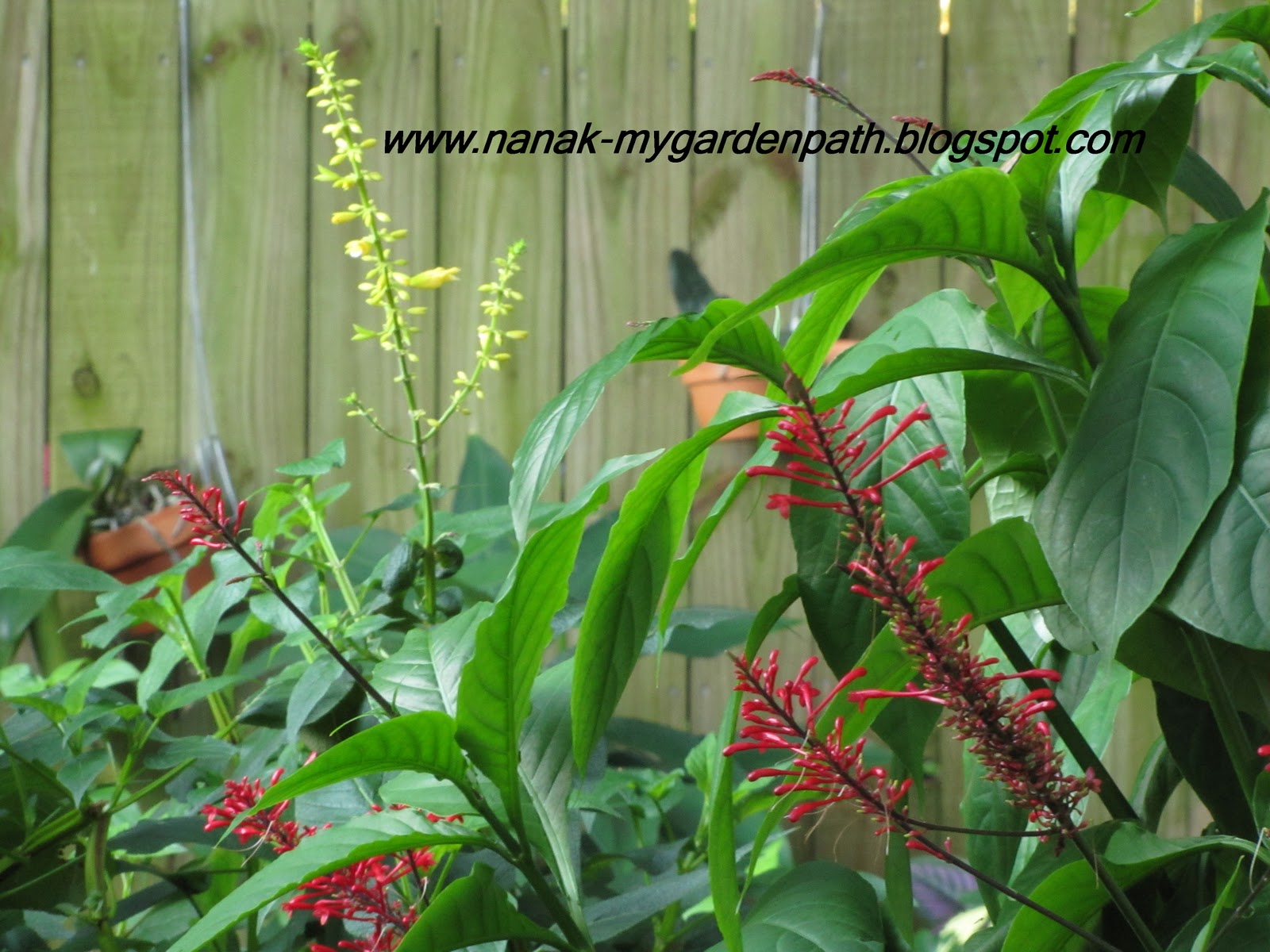
Forsythia Sage, Salvia madrensis and Red Firespike, Odontonema strictum

My favorite Fall flowering combination is this Red Firespike and Forsythia Sage blend.  The butterflies and hummingbirds love these two as well.

I have noticed more buds forming on other Fall blooming plants which are nice to see as many of the Summer bloomers are closing up and fading away.  I love witnessing the changes of season in the garden even though, here in central Florida, those changes are very subtle.

Thursday, January 20, 2011

A Cold Calculating View

As I walk around the garden these days I do so with a view to assess what has worked well during this cold winter season.  I want to be sure to place more of these plants to help keep some structure going at all times of the year.


Sweet Alyssum, Lobularia maritima, is still blooming and reseeding on the sunnier side of the garden.  It and the Pansies, Viola x wittrockiana,  make a great winter annual combination.  There are lots of little seedlings of something sprouting up in that area.  I sure hope they aren't really weeds.  Since there were blanket flowers and some other butterfly attracting flowers there this past spring, I'm waiting to see what they turn into before pulling them.


Two baby Cardboard Palms, Zamia furfuracea, live along the path and amazingly they both have come through the cold unscathed.  The oak canopy must offer them just the right amount of protection.  This is just another example of micro-climates within the same gardening zone.  Often, I see plants that seem cold-hardy or heat-tolerant in another garden only to find they don't react the same way in my garden.  In this case the opposite happened.  I saw freeze-dried Cardboard Palms in another garden and thought for sure mine would never make it as my garden tends to be in a cold pocket.  The tree coverage seems to be the key to helping these little cycads survive.  The Neoregelia 'Burgundy' are doing quite well placed in front of the Sweet Almond bush.  The poor Sweet Almond, Aloysia virgata, while not seemingly affected by the cold, has had it's leaves pierced and beaten by an overabundance of falling acorns.


The Birdsnest Fern, Asplenium nidus 'Osaka', and Holly Fern, Cyrtomium falcatum, have earned their spots with their ability to not show even a smidgen of winter stress.  Definitely, I am on the look-out for more of these.


The Abutilon is still blooming and producing new leaves.  There seem to be many cultivars of this plant, different colors, and different flower sizes.  I do like the light peach color with dark red veining of this one, but I'm going to be on the look-out for some other colors too.  After the last December freeze some of the larger leaves turned yellow and dropped off.  You would never know it now as it is full of new green growth and weathered the January freeze just fine.  Sometime in February, when the promise of spring is more sure, I plan to take cuttings and spread this cold survivor around in other places along the path.  As an added bonus, the hummingbird visited this plant quite often this past fall.


Lots of Florida gardeners are singing the praises of Camellias this year.  This, Camellia sasanqua 'Shishi Gashira', is blooming in the backyard garden.  Two more Sasanquas have been purchased to add to this area, another 'Shishi Gashira' and a 'Mine-No-Yuki.'  The second one has a ruffly white flower which I'm hoping will be showing up in future posts soon as it is presently covered in buds.

I am thoroughly enjoying the glorious Florida weather we have been experiencing this week.  It sure gets the gardening juices flowing. 

Saturday, October 16, 2010

Garden Cousins

So many plants along the Path are just starting to bloom after spending the spring and summer growing tall and leafy.  Two such specimens are the Abutilons which were purchased from the Hillsborough County Jail Horticulture Program for $1.00 a piece last fall. 

Abutilon x hybridum

Flowering Maple is the common name for this plant which has reached a height of about 8 feet.  Last year at this time it was just an 8 inch rooted cutting.  Kept in its pot on the backporch through all the freezing weather of winter, it was planted in the dappled shade as soon as the weather warmed a bit. 


The cute little latern shaped blooms are just beginning to open the entire height of the plant.  They really do look like lanterns when the sun shines through them.
 

The blooms are quite small compared to the extra-large maple shaped leaves on this plant.  Though not related to a maple tree, there is a certain resemblance.  The resident hummingbird loves these blossoms.


The other Abutilon which was purchased has a very similar bloom.  The leaves, however, do not have the maple leaf shape.  They are more heart shaped and both leaves and stems are hairy in texture. 

Abutilon hulseanum

The common name for this plant is Red Indian Mallow.  It grows well in the boggy area of the back yard.  Large seedpods develop after the flowers which may mean there will be a lot of this Abutilon next year. 


Having grown straight up to a height of 6 feet with little branching, this plant adds large leaved interest to the back fence area.  The spot in which this Red Indian Mallow seems to thrive is a tough environment.  During the rainy season it is a boggy area but other seasons it is quite dry.  This plant has been a trooper through both situations.  The hummingbird hasn't been seen visiting this Abutilon yet, but since this planting is far away from the house, perhaps it's just a matter of missing the right viewing moment. 

It's easy to see the family resemblance between these two Abutilons.  They both sport small, bell shaped flowers and they both like a moist environment.   The $1.00 each cost seems to have been a good investment.